06.07.13

Andrea Bringing Heavy Rainfall To Jersey

Posted in Storm Track, Commentary, Storm Facts, Storm Preparation, GWC News, Storm Safety, Tracking the Tropics, Model Forecasts at 2:38 pm by gmachos

First Storm Of Atlantic Season Dumping Significant Rain On Garden State

Over the past 24 hours or so, Tropical Storm Andrea has made landfall just north of Cedar Key in the Big Bend region of the Florida Gulf Coast.  The storm brought 4 to 6 inches of rain, tornadoes, and maximum sustained winds of 65 miles per hour to Florida, Georgia, and South Carolina.  Tropical Storm Watches and Warnings extended up to the Cape Charles region of Virginia.

The storm has weakened throughout all of this.  As of the 2:00 PM EDT Advisory from the National Hurricane Center, maximum sustained winds have dropped to 45 miles per hour.  Minimum central pressure has risen a bit to 29.41 inches of Hg, or 996 millibars.  Pressure has risen by 3 millibars, or 0.09 inches of Hg in the last 21 hours.  Tropical storm force winds extend some 230 miles from the center of circulation.

Currently located some 5 miles to the Southwest of Fayetteville, North Carolina, or 70 miles to the Northwest of Wilmington, North Carolina, Tropical Storm Andrea has almost doubled in forward speed at 28 miles per hour.  This time yesterday, it was moving more modestly at 15 miles per hour.  The increase in forward speed is good news for those still in the path of the storm.  The storm system also is losing its tropical characteristics.

Since late Thursday afternoon, the combination of a cold front and the moisture from Tropical Storm Andrea has brought 1.3 inches of rain to Northwestern Middlesex County.  Rainfall rates at the GWC weather station are approaching an inch per hour.  Temperature and dew point are both  in the low 60s thanks to the cloud cover and moisture from Andrea.  Barometric pressure has fallen steadily in the past 24 hours.   Since Thursday afternoon, there has been a pressure drop of 0.30 inches, or 10 millibars to 29.78 inches of Hg.

Just before sitting down to type of this report and analysis, I ventured out into  town after hearing from my mother that waters were rising at Spring Lake Park, and a creek over by a nearby railroad track.  The lake and the nearby creeks have swollen.  In the park, the water has risen to within just a few feet of some of the park benches on the one side of the park adjacent to  the Fire Department.  The rising waters have produced a debris line around the lake.  The brunt of the storm is still to the south of New Jersey, so more rain is on the way.

Forecasts have been calling for between 2 to 4 inches of rain.  Looking at the forecast track, it appears that the center of Andrea will pass over the Southeastern portion of the Garden State so coastal counties such as Ocean, Atlantic, and Cape May should see the brunt of the wind and rain from Andrea.

06.06.13

Andrea Emerges And Strengthens In Gulf

Posted in Storm Track, Storm Facts, Storm Preparation, GWC News, Storm Warning, Tracking the Tropics, Model Forecasts at 5:17 pm by gmachos

First Named Storm Of 2013 Atlantic Season To Bring Rain And Wind From Florida To Mid-Atlantic

Over the past several months, several seasonal prognostications have come out with indications that the 2013 Atlantic Hurricane Season will be extremely busy.   Not even a week into the new season, the first named system of the year has developed, and is threatening to impact a large swath of the East Coast of the United States from Florida to the Mid-Atlantic including New Jersey.

Currently, Andrea is in the Northeastern Gulf near landfall in the Big Bend area of the Northwestern Florida coast.  Maximum sustained winds as of the 5:00 PM  EDT advisory from the National Hurricane Center were 65 miles per hour.  Barometric pressure is down to 993 millibars, or 29.32 inchees of Hg.  Andrea is moving to the Northeast at 17 miles per hour.  Tropical Storm force winds reach out some 140 miles from the center.  The latest observation out of Cedar Key, Florida had a sustained wind of 41 miles per hour with a gust up to 54 miles per hour.

The storm had emerged on Thursday afternoon after being a broad and disorganized area of low pressure.  Andrea wasn’t even classified as a depression.  Rather, it went straight from an Invest to a Tropical Storm with minimal strength winds of 40 miles per hour.  Andrea had a flare-up of thunderstorms late last night after struggling to hang on for much of the evening.  The storm has been battling strong upper level winds as well as a lot of dry air to the west of it.   Nevertheless, it was able to intensify.  The satellite and radar animation has depicted thunderstorm activity attempting to wrap around the center of circulation.  

While Andrea will bring rip currents, storm surge levels between 2 to 4 feet, and a threat of  tornadoes in Florida, the significant problem that the storm will present is the combination of some gusty winds and heavy rains, especially as it moves further up the coast.  Combining with a frontal system approaching from the west, what is left of Andrea could bring anywhere from one to three inches of rain in the Mid-Atlantic with some areas receiving up to 5 inches.  The National Weather Service in Mount Holly has issued a Flash Flood Watch for Delaware, Maryland, most of New Jersey including Middlesex County, and Eastern Pennsylvania.

The forecast models are all in very good agreement on where this storm is going to go.  It is currently making landfall in the Big Bend area of Florida, and then Andrea will continue to move northeastward into Southern Georgia.  On Friday, the storm will proceed through the Carolinas into the Mid-Atlantic, and be just to the south of Cape May by 8:00 PM Friday night.  New Jersey should experience heaviest rain from Andrea  from  late Friday afternoon into Friday evening.

Clouds have been gathering all day in the Garden State, but no precipitation has fallen yet here in Northwestern Middlesex County.  The region had been experiencing a brief stretch of fine weather after the storminess that developed late Sunday into portions of Monday.  Overall, conditions have been relatively dry here in New Jersey.  Here in South Plainfield, there has been 13.11 inches of rain so far this year.   In addition, temperatures have been a bit cooler than the same period last year with the first 90 degree days of the year occurring during last week’s heat wave.

11.06.12

Nor’easter Threatens Storm Weary Jersey

Posted in Storm Track, Commentary, Storm Preparation, GWC News, Storm Safety, Model Forecasts at 7:09 am by gmachos

Timing Couldn’t Be Worse For Garden State Residents Trying To Recover From Sandy

Hurricane Sandy couldn’t have struck at a more worse time for the Mid-Atlantic and Northeast. The monster storm, which put a devastating hit on the Jersey Shore as well as Staten Island, Long Island, and Coastal Connecticut hit late in the hurricane season, and just as the winter season is beginning to wind up. Nor’easters are becoming more commonplace now including one that is taking shape to give Jersey and its neighbors a good pounding starting Wednesday and lasting into Thursday.

Forecast model guidance in the late afternoon on Monday hinted at not only a storm that would bring two inches of rain, 60 to 70 mile per hour winds along the coast, and coastal flooding, but also the first significant snowfall of the season according to Tri-State Weather. As much as 8 inches of snow was forecast for parts of the area with the heaviest snowfall occurring at around rush hour. Inland areas were going to get winds between 40 and 50 miles per hour, which is still not good for dangling power lines, weakened trees and telephone poles. Thankfully the late night and early morning model runs have the storm a little bit farther to the east, and not giving as big a blow as earlier.

There is still concern though. Forecasters are closely watching how this storm develops, and everything rides upon how the upper level low and the surface low come together. A vort max over the eastern part of the country has not dug far enough south, which is putting the storm on a forecast track further east. If the surface low can catch up to the upper low, then we could have a track more toward the coast, which would be insult to injury. If they do not come together, then the storm moves further to the east. Some towns along the Jersey Shore are not taking any chances.

In Brick Township, located in Ocean County, a mandatory evacuation has been issued in advance of the storm. Expect more of these to start rolling out as the day progresses on Tuesday. With much of the Garden State coastline in shambles, and another storm on the way, municipalities and the state government will take extra measures to ensure people’s safety. Hurricane Sandy and this approaching nor’easter could be the opening salvo in what could be a brutal winter. A few months ago, seasonal forecasts came out for the winter season in the Northeast, and there were indications that it would be a very bad winter in this region. Not the type of news residents along the Jersey Shore and the rest of the Mid-Atlantic need to hear right now while they try to pick up the pieces.

10.29.12

Sandy Truly A Superstorm Of  Epic Proportions

Posted in Commentary, Hurricane Intensity, Hurricane Records, Tracking the Tropics, Model Forecasts at 11:46 pm by gmachos

Hurricane/Nor’easter Makes Mark Comparable To Superstorm ‘93

Hurricane Sandy is done as a tropical cyclone, but it will be a storm long remembered by many, especially in the Mid-Atlantic States of Maryland, Delaware, New Jersey, New York, and even Pennsylvania.  Of all the storms that I have lived through including Irene last year, this was the worst.  Not just the worst tropical storm or hurricane, but the worst storm period.  The legacy of Sandy here in New Jersey, New York, and Long Island will be the wind and surge.

This large and powerful storm produced tremendous winds by Jersey standards with winds whipping frantically for several hours on Monday night.  The winds had been picking up during the afternoon, but then around the 5:00 PM hour, they appeared to abate in Atlantic City and New York City.  About a hour later though they dramatically picked up again, and increased to as high as 100 miles per hour.  Here at the hotel that I am staying at, the winds have been relentless, and it felt like they were going to bust through the window in my room.

By the way, the winds aren’t going to slacken for a while either.  The slow moving storm will cause the high winds to linger for at least another 24 hours.  Along the coast, there was the surge.  A record surge was set in New York Harbor at King’s Point (13.3 feet) and Battery Park (13.7 feet).  Sandy Hook also was hit with a record surge of 13.3 feet.   The previous record for surge in New York Harbor was from the 1821 hurricane. The barometric pressure fell to 940 millibars, or 27.76 inches of Hg before the storm turned post-tropical and came ashore.  At GWC, the barometric pressure fell to 28.42 inches of Hg (Mercury) or 962 millibars, which shattered the record of 970 millibars set in Hurricane Irene last year.

The storm has left New York City as well as many locales around New Jersey reeling.  Flooding has occurred in many parts of the area, especially near the coast.  Trees have fallen on people.  A crane has partially collapsed in Midtown Manhattan.  Water poured into the PATH station in Hoboken.  Fires have broken out.  Transformers have blown all across the region.  Almost 5 million people have been left without power around the region.   Trees were down across Route 18 near Sayreville.  Power was out throughout much of Sayreville, Old Bridge, South Amboy, and Colts Neck.  This storm could end up making Hurricane Katrina look like a walk in a park.

It was a very well predicted storm.  Much like Superstorm ‘93 was almost 20 years ago, Sandy was picked up quite well in the models, and even in terms of its intensity and conversion from a tropical to post-tropical system.  The storm lived up to the hype and was well behaved from a forecast standpoint.  The similarities between Sandy and Superstorm ‘93 didn’t stop there.  Sandy was a storm that had winds stretch across some 1,000 plus miles at peak size.  It covered not only the Mid-Atlantic, but also New England, and the Great Lakes States. Approximately 60 million people were affected. Similarly, Superstorm ‘93 affected some 26 states when it was all said and done.  Like Superstorm ‘93, Sandy brought a variety of weather including a record storm surge, tornadoes, and blizzard conditions to some of the affected areas.

Keep in mind that we are still scratching the surface of this weather event.   The true scope of the devastation from this storm will begin to be revealed with daylight on Wednesday.  Many things will not sort themselves out until later in the week.  Nevertheless, if we are just talking the shear meteorological numbers, Hurricane Sandy, or Superstorm Sandy has truly been a historic storm.  Something I as well as all of you will long remember.

10.25.12

Big Storm Scenario For Northeast More Likely

Posted in Storm Track, Commentary, GWC News, Hurricane Anomalies, Tracking the Tropics, Model Forecasts at 9:28 pm by gmachos

Hurricane Sandy To Morph Into Landfalling Perfect Storm

It has been 21 years almost to the day of the Perfect Storm, and 58 years since Hurricane Hazel came roaring into the Mid-Atlantic.  Now, the Northeastern United States is looking at a possible landfall from one of the more rare and powerful storms to make a left turn into the region in recorded history.   Hurricane Sandy first developed in the Caribbean on Monday as the 18th named storm of the 2012 Atlantic Hurricane Season.  Since that time, the storm has grown to near major hurricane strength.

Sandy significantly strengthened on Wednesday from a strong tropical storm to high end Category Two Hurricane with winds of 110 miles per hour as it approached the southeastern coast of Cuba.  The storm has weakened a bit since crossing Cuba and moving into the Bahamas, but the storm is going through changes that could make it even more devastating.  The environment around Sandy has a cold front to the west, and a dip in the jet stream that will allow this hurricane to morph into a hybrid storm combining elements of a nor’easter and a tropical cyclone.

Hurricanes are much different than the usual storms we see here in the Northeast.   They are warm core and barotropic systems, which means that they have warm air around the center of circulation, or the eye, and have a cloud structure profile that is completely vertical.  The upper level and surface low pressures in a hurricane are stacked on top of each other, which is not the case for nor’easters, or what meteorologists define as a Mid-Latitude Cyclone.  Storms that usually effect the Northeast are cold core lows and baroclinic.  

Mid-Latitude Cyclones have cold air around the area of low pressure, and the cloud structure is sloped or slanted because the upper level low and surface low are not on top of each other.  Nor’easters tend to like wind shear, or wind going in different directions at different heights of the atmosphere, involved because of this while hurricanes do not like shear at all.  Another difference between hurricanes and nor’easters is the wind field.  Hurricanes tend to have the strongest winds near its core while nor’easters have winds cover more larger area.

With all of this in mind, we return to Sandy, a storm that is about to undergo a radical transformation from a storm system that has a warm core and is baroptric in nature to one that has more of a cold core and is more baroclinic in nature.  To what degree this transformation goes remains to be seen, but already Sandy’s wind field is expanding.  As of 8:00 PM this evening, hurricane force winds extend some 35 miles from the center while tropical storm force winds reach out some 205 miles.  Pressure is already low at 965 millibars, or 28.50 inches of Hg.

So, we have significantly low pressure with Sandy, a cold front approaching from the west, a significant dip in the jet stream, and a lot of warm moist air ahead of the front over the Northeast and Mid-Atlantic.  It was been a fairly mild and humid autumn so far in New Jersey.  True, there have been some days of chilly weather with the first frost  happening a couple weeks or so ago, but overall, temperatures have been quite mild.   Put all of these ingredients together, and mother nature has quite a storm to cook up.  

Currently, Sandy is moving through the Bahamas.  The most recent advisory on Thursday evening had the storm centered  between Cat and Eleuthera island in the Bahamas.  Winds have decreased since late last night from 110 miles per hour to 100 miles per hour, and the pressure has risen a bit, but don’t be fooled by this.  As Sandy approaches the Mid-Atlantic and Northeast early next week, it will still be quite a potent storm, maintaining much of its strength as it moves over the warm water of the Gulf Stream, and generating energy as a result of its transformation into a hybrid storm.

Changing to more of a cold core or baroclinic storm will require some transfer of energy.  This transfer of energy will make what is left of Sandy more powerful and dangerous.  The storm will also grow in size thanks to its larger wind field so a large area of strong winds will be felt in the Northeast and Mid-Atlantic.   Have we seen such a circumstance where this has happened before?  The answer is yes.  Back in late October 1991, the Perfect Storm developed from the combination of a cold front, a strong jet stream, and Hurricane Grace, a Category One storm that formed near Bermuda.  However, that storm never made landfall.  This one has a very strong likelihood of landfall somewhere from Delaware Bay to Maine.

The latest forecast models are coming closer together on a track for this  potentially powerful and dangerous storm.  Earlier in the week, the GFS (American model) and ECMWF (European Model) were a bit apart on a forecast track.  The GFS had the storm coming ashore somewhere in Maine while the ECMWF had it moving into Delaware Bay.  Now, they are much closer together with the European still moving through the Mid-Atlantic near Delaware Bay while the GFS is further south with an impact along the Jersey Shore.  Both of these scenarios do not bode well for the Northeast.  

After dodging a bullet with Irene back in August 2011, the Northeast and Mid-Atlantic States could be staring down at a monster of a storm early next week.  A region that has been long overdue for a powerful storm may be making up for lost time come Monday or Tuesday.

08.24.12

Isaac Gets Stronger And Better Organized

Posted in Storm Track, Commentary, Storm Preparation, Storm Warning, Storm Safety, Tracking the Tropics, Model Forecasts at 9:04 pm by gmachos

Storm Gradually Gains Strength On Friday As It Nears Hispaniola

Tropical Storm Isaac is gradually gaining strength as it moves through the Central Caribbean toward the southwestern coast of Haiti on this Friday night. The storm, which still remains somewhat disorganized thanks to some dry air getting into its western flank, has been slowly strengthening all day today with winds increasing to 60 miles per hour by 11:00 AM EDT, and then going up to 65 miles per hour by 5:00 PM EDT.

Maximum sustained winds with Isaac remain at 65 miles per hour with gusts of minimal hurricane force. Minimum central pressure is down to 29.29 inches of Hg or 992 millibars, which is actually down two millibars from the late afternoon advisory.

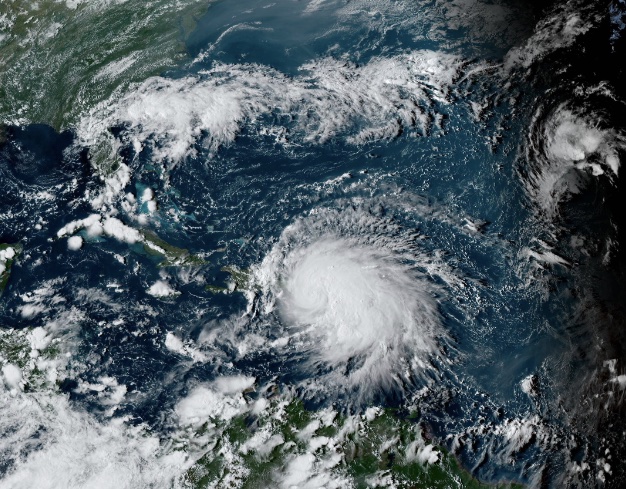
The satellite imagery shows a storm that has done a bit of a 360 in the past 24 hours or so. Yesterday at this time, much of the convection was on the western side of the storm. Now, it is on the usually more stronger eastern side. There is good outflow, or exhaust from the storm except for the northwestern part, and that is where the dry air appears to be getting into the system. There has been a trough to the west of Isaac as well, and that may be contributing to the storms continued struggles. Now, it is beginning to interact with the rugged terrain of Hispaniola, which has mountains as high as 10,000 feet on the Dominican Republic side.

The interaction between these mountains and Isaac will cause orographic lifting of the tropical air to take place, and that will cause tremendous condensation and torrential rains. Streams of moisture have already been flowing into the southern portion of the Dominican Republic. Those rains and more are expected to impact Haiti, where many are still living in tents around Port Au-Prince following the deadly and devastating earthquake there several years ago. Currently, Isaac is located some 165 miles south-southwest of Santo Domingo, the capital of the Dominican Republic, or about 185 miles to the south-southeast of Port Au-Prince.

The big story is that the storm has slowed down, which also adds to the fears of significant flooding and mudslides across Haiti and the Dominican Republic. The National Hurricane Center has Isaac currently moving at 10 miles per hour, which is down from 16 miles per hour just a few hours ago. Consequently, the NHC is forecasting some 8 to 12 inches of rain for Hispaniola with some areas receiving 20 inches. Further to the west across Cuba and even Jamaica, some 4 to 8 inches are expected with isolated areas getting up to a foot of rain. Puerto Rico is still receiving rain, and could get up between 2 to 4 inches with some remote locations seeing 6 more inches.

There are a lot of watches and warnings out for this storm. Currently a Hurricane Watch is in effect for Haiti. A Tropical Storm Warning is in effect for the Dominican Republic, Haiti, the Cuban provinces of Ciego de Avila, Sanctus Spiritus, Villa Clara, Camaguey, Las Tunas, Granma, Holguin, Santiago de Cuba, and Guantanamo, Andros Island in the Bahamas, the Central Bahamas including Cat Island, The Exumas, Long Island, Rum Cay, and San Salvador, the Southeastern Bahamas including the Acklins, Crooked Island, Long Cay, the Inaguas, Mayaguana, and the Ragged Islands as well as the Turks and Caicos.

Tropical Storm Watches were first issued for the United States mainland during the 5:00 PM EDT Advisory. Now, they are in effect for the provinces of Matanzas and Cienfuegos in Cuba, Jamaica, the Northwestern Bahamas including the Abacos Islands, the Berry Islands, Bimini, Eleuthera, Grand Bahama Island, and New Providence, the Florida Keys including the Dry Tortugas, the East Coast of Florida south of Jupiter Inlet, the West Coast of Florida south of Bonita Beach, Florida Bay and Lake Okeechobee.

Looking at the most recent model runs of the GFS, GFDL, ECMWF, and HWRF, there is a general northwestward track with the GFS being the furthest east, and the ECMWRF being the furthest west but they all show an impact in South Florida, and a second landfall somewhere along the Gulf Coast.

The latest GFDL model run has Isaac moving across the southwestern coast of Haiti into the narrow channel between Hispaniola and Cuba, traveling over the spine of Cuba and impacting the Florida Keys and South Florida before moving over water again in the Gulf, and eventually making a final landfall in the Florida Panhandle.

The GFS, which actually did a fairly decent job last week of projecting that the storm would be in the general vicinity of the Eastern Caribbean at about this time, has Isaac going across southwestern Haiti, but then going further to the north into the Southeastern Bahamas and more of South Florida before exiting into the Gulf, and eventually making a second U.S. landfall in the Pensacola, Florida and Mobile Bay, Alabama area.

The ECMWF has a more western track that goes across more Cuban real estate before emerging into the Gulf and making a U.S. landfall along the Mississippi and Alabama coasts. Finally, the HWRF has a smaller storm following a similar path of the GFDL across Haiti, along the spine of Cuba and over portions of South Florida, back out into the Gulf, and making landfall in the Pensacola, Florida area.

However, those in Western Florida including Tampa where the Republican National Convention is being held, should pay close attention to the track and progress of this storm since that area is not out of the woods just yet. The cone of uncertainty has not changed much during the day on Friday, and there are still areas along the West Coast of the Sunshine State that could be impacted by this storm.

The 5:00 PM EDT forecast discussion by the NHC is still calling for Isaac not to strengthen much over the next 12 hours, and it will likely weaken as it encounters the high terrain of Hispaniola and Cuba over the next 36 hours. After that, the storm should strengthen as it enters the Florida Straits and Gulf Coast, and become a strong Category One storm with 85 mile per hour winds.

08.23.12

Isaac Struggling To Get Its Act Together

Posted in Storm Track, Commentary, Storm Preparation, Storm Warning, Storm Safety, Tracking the Tropics, Model Forecasts at 12:25 pm by gmachos

Vast Storm Battling Lots Of Dry Air And Tug Of War Between Multiple Vortices

On Tuesday afternoon after much anticipation, Tropical Depression Nine in the Western Atlantic was found by Air Force Reconnaissance aircraft to be strong enough and well organized enough to become the ninth named storm of the 2012 Atlantic Hurricane Season. Since then, things have been a struggle for Tropical Storm Isaac.

The storm, which has grown to be about the size of Texas, remains in rough shape on this late Thursday morning. Dry air to the north, west, and south of the storm has been one factor that has made it very difficult for the storm to strength. Another issue is the circulation itself, or should we say multiple circulations. As pointed out on the evening broadcasts from The Weather Channel, Isaac has had to deal with several competing vortices that are all battling to take over the storm.

One appeared further to the south and west of the actual center while another was to the north of the storm. Thunderstorms have struggled to wrap around the circulation. To sum it all up, Isaac was literally one big mess. Since then, Isaac has reformed further south. A consequence of that appears to be a more westward track, but that will not keep it from interacting with the mountainous terrain of some of the bigger islands such as Hispaniola, which has mountains as high as 10,000 feet, and Cuba, which has mountains as high as 6,000 feet.

Moving more westward, Isaac will also be more over water and become a threat for the Central Gulf Coast states of Alabama, Mississippi, and Louisiana. Still a lot of time to watch it though, but last night, the European Model did indicate that the storm would take a more westward track into the Gulf by early next week. The GFS had indicated more of a track toward the west coast of Florida, where the Republican National Convention is scheduled to take place in Tampa. Orange futures were up five percent on Wednesday in response to the possible threat from Isaac.

As of the 11:00 AM EDT Advisory on Thursday from the National Hurricane Center, Isaac had weakened to minimal tropical storm force with maximum sustained winds of 40 miles per hour, gusts of up to 50 miles per hour, and a minimum central pressure of 1003 millibars, or 29.62 inches of Hg. Tropical storm force winds extend some 140 miles from the center. Isaac had basically remained at the same intensity all day on Wednesday with maximum sustained winds of 45 miles per hour, and a minimum central pressure of 1003 or 1004 millibars before weakening slightly overnight and this morning.

There did appear to be some signs that Isaac was going to get its act together on Wednesday night. Convection to the north of the center looked like it was trying to wrap around the center, which is an indication of intensification. However, Issac’s center reformed further south and the storm lost some strength overnight. The latest forecast discussion indicates that while the satellite imagery indicates some improvement with the system, Air Force reconnaissance still finds the system very disorganized. The intensity forecast calls for gradual intensification with Isaac becoming a hurricane within 36 hours. Sea surface temperatures and upper level winds are just right for rapid deepening, but as long as the storm’s core struggles to get organized, it will not be able to take advantage of the environment.

After Isaac becomes a hurricane, it will start interacting with land and weaken by 72 hours before moving out over water again and strengthen by 96 to 120 hours. The forecast also indicates that despite the reformation to the south, and a more westward track, Isaac could still be a problem for Florida.

08.21.12

Tropical Depression Nine Forms In Western Atlantic

Posted in Storm Track, Commentary, Tracking the Tropics, Model Forecasts at 1:15 pm by gmachos

Depression Moving Rapidly Toward Lesser Antilles; Two Other Disturbances Still Being Watched

Recently, Governor Chris Christie of New Jersey encouraged people to head for the Jersey Shore over these final weeks of summer.  Quite a contrast from the caution he had this time last summer as Hurricane Irene came up the coast.  The governor may want to go back to that cautious approach because the tropics are becoming very active with a new tropical depression and another disturbance getting better organized.

The depression emerged from a well organized tropical disturbance in the Western Atlantic.  This disturbance had been watched for the past several days, and had been gradually improving in organization.  Now, the depression could become a tropical storm later today.  Hurricane Hunter aircraft is scheduled to fly into the area this afternoon to see if the depression is actually organized enough to become a storm.  As of the 11:00 AM Advisory from the National Hurricane Center in Miami, Florida, Tropical Depression #9 is located 580 miles to the east of Guadeloupe in the Lesser Antilles.

The system is rapidly moving to the west at 20 miles per hour.  Maximum sustained winds are still at 35 miles per hour with gusts up to 45 miles per hour.  Minimum central pressure is still fairly high at 1008 millibars or 29.77 inches of Hg.  A Tropical Storm Warning is now in effect for Martinique, Dominica, Guadeloupe, St. Martin, St. Kitts, Nevis, Antigua, Montserrat, Antigua, Barbuda, Saba, St. Eustatius, and St. Maarten.  A Tropical Storm Watch is in effect for Puerto Rico, Vieques, Culebra, U.S. Virgin Islands, and the British Virgin Islands. 

Looking at the latest forecast discussion from the NHC, there is a burst of convection or shower and thunderstorm activity in the southern semicircle of the system.  A light amount of wind shear is occurring from the northeast of the depression, but that should diminish with time.  With increasingly conducive upper level dynamics as well as adequate sea surface temperatures, the depression should become a storm within the next 12 hours, intensify to a hurricane by 48 hours, and be a Category Two Hurricane by landfall in 5 days.

The GFS model runs have been showing a low pressure system coming into Florida and the Southeastern coast by August 26 and 27th.  The GFS is actually to the left of the ensemble forecast tracks.  Some models are indicating that a shortwave will enhance a trough that will then dig southward into the Southeastern United States and the Gulf of Mexico causing the ridge over Florida and the Bahamas to erode and retreat.  Meanwhile, there are still two other disturbances being monitored in the tropics while Gordon has become post-tropical.

The first disturbance, located some 425 miles to the Southwest of the Cape Verde Islands.  It has a well defined circulation and shower and thunderstorm activity are getting better organized according to the NHC.  Moving to the far west into the Gulf of Mexico, there is another area of disturbed weather off the Northeastern coast of Mexico still producing poorly organized showers and thunderstorms.  Close proximity to land is hindering development, but there is a 30 percent chance that the disturbance could become a tropical cyclone.  Finally, Gordon is gone.  The storm was declared post-tropical at the 5:00 PM Advisory on Monday when it was located some 370 miles to the East-Northeast of the Azores.

08.18.12

Latest GFS Model Runs Look Interesting

Posted in Commentary, Storm Preparation, Model Forecasts at 2:23 pm by gmachos

Since last week, I’ve been periodically checking out the GFS model runs, and they have continued to hint at an East Coast storm sometime in the future.  The time frame has gradually pushed out from August 20th to August 22nd last week to now Labor Day Weekend.  Interesting way to end the summer, and begin my vacation.

The first model runs from yesterday’s 18z (2:00 PM EDT) run showed a storm coming right up the Eastern Seaboard and making landfall across Long Island and going up into New England.  The 00z run from 8:00 PM EDT showed the storm moving more to the right out into the open Atlantic.  The next run from 06Z, or 2:00 AM EDT showed the storm moving back over to the left and making landfall again across Long Island.  The 12Z (8:00 AM EDT) run showed the storm making a track more to the left and over land in the Caribbean before turning north and heading into the U.S. coast in the Carolinas.

The storm appears to be developing around the time of August 25th when it first enters the model loop animation near Puerto Rico and the Lesser Antilles.  It eventually tracks into the Mid-Atlantic and Northeast around the August 31st to September 3rd time frame depending on what model run we are looking at.  Again, this is two weeks out so there is a lot of time for things to change.  They can even change as quickly as the next model run.  Waves are moving off the African coast now, and one in particular is showing signs of tropical formation.  So, we’ll have to keep an eye on the tropics to see if anything will come up this way.

The tropics are heating up.  The statistical peak of the season is less than a month away (September 10th).  Time to get prepared.